
(Why my AI agents get clearer rules than my people do)
I give agents clear rules because they have nothing else. No memory and no relationship. I give people a relationship and a pile of processes without one clear plan.
Recently I asked my team to write its own OKRs. I did not give them a horizon, an objective or a single target. Each team read the mission and the strategy and came back with its own proposal. My answer was short. "Good direction, but the bar is too low."
They came back with higher targets and rated their own confidence at 30 to 50 percent. I approved the new version the same day. There were no people in this team, only AI agents I had built myself.
A team that forgets everything overnight
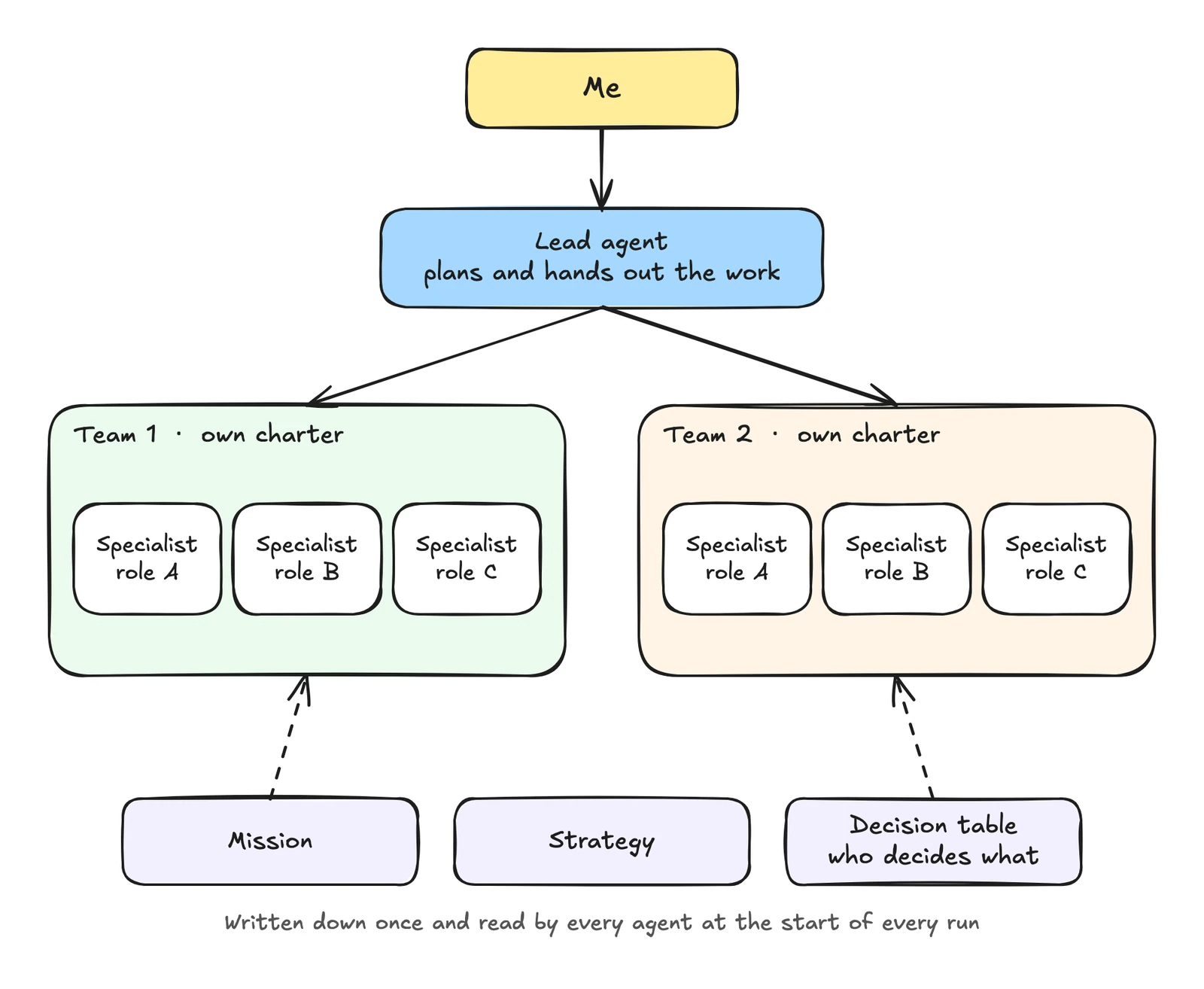
The setup is simple to describe. I talk to one lead agent that plans the work and hands it to two small teams of specialist agents. Each agent has its own role and each team has its own charter. The whole organisation has a written mission, a strategy and a table that says who decides what.
Agents do not remember yesterday's conversation. Everything they need has to live in files they read at the start of every run. So I had to write down what a human company usually leaves to culture. Every task gets a goal, a scope, acceptance criteria and a condition to stop. Every decision goes into a log and every piece of work passes a gate before anybody calls it done. None of these rules stands on its own. Each one traces back to the same mission and the same decision table, so the whole system reads as one plan.
What I never hand over
The decision table has a short list of things only I decide. Spending money, publishing anything in public, irreversible actions and changes to the mission stay with me. Agents and the lead decide research, documents, code, tests and the order of the backlog.
Publication and money are the two I will never give away. An agent can easily get carried away and the risk is simply too big. In July 2025 an AI coding agent deleted a production database during a code freeze. The interesting part is that I would not be afraid to give exactly these two things to people. People carry accountability for what they publish and spend and they can stop themselves before it goes wrong. An agent has neither.

Agents agree too easily
One fact about my setup worries me more than it pleases me. The lead agent has accepted every piece of work the team delivered so far and nothing was rejected. When one agent judges the work of other agents a perfect score is a warning sign rather than proof of quality. I wrote about the same trap in The Illusion of Accuracy.
I suspect the low bar on the OKRs came from the same place, because nobody in the team pushed back on its own plan until I did. With agents the challenge has to be designed into the system. Anthropic's research on agent autonomy points the same way. Experienced users do not stop supervising agents but stop approving every step and start watching and interrupting instead.
A perfect acceptance rate tells you more about the judge than about the work.
Let's be honest. What I still have not done is read a random sample of the accepted work myself. Until I do I cannot say how good that perfect score really is.
Then I looked at my own teams
Building this team made me look differently at my day job in the company where I have worked for ten years. Over the last years I introduced changes to reduce KTLO (keep the lights on) work through better planning. Right now we work on quarterly planning, bug triage, support triage and new support processes. A lot is happening at the same time and it feels like we turn our SDLC upside down every month.
Every one of these changes costs a lot even though I use the ADKAR model to introduce it. I announce the new process at an all-hands meeting. Then I meet the team three times, introduce metrics, watch them closely and ask on syncs whether we really see progress. It takes a lot of time and attention from everyone involved.
That was the moment it clicked for me. With agents I wrote the whole system down as one simple plan because they would not cope without it. With people I keep adding processes and expect them to cope because they are professionals.
A good example is our support and bug SLA against sprint predictability. To keep the bug SLA we add a lot of work in the middle of the sprint and sprint predictability gets worse. Each of these processes makes sense on its own, but together they pull the team in two directions.
The "they are professionals" trap
We expect people to know what to do because they are experts in their domains. Then we put them into teams, give them an SDLC and keep adding processes that contradict each other or simply do not help. People are not robots that read a procedure and start following it the next morning. Every change needs time before it sticks and the next one often arrives before that happens. I call it the "they are professionals" trap.
Agents and people fail here in a similar way. An agent without clear rules loops and gets stuck repeating the same step. A team under constantly shifting processes can do the same. I suspect people cope with chaos better than agents do. That is also why we let the chaos go on for too long.
What I would do differently with people
I do not want to manage people like agents. People have relationships and emotions and that is a strength. But the system around them deserves the same care I gave my agents. That means one simple plan for the whole team with clear goals, scope, boundaries and responsibilities. It also means few enough processes that they support each other instead of competing for attention. The first step is simple. List every process your team follows today and ask the team which one they would drop first.
The key difference is who writes the rules. My agents write their own targets but receive the operating rules ready-made. People should help write the operating rules too, because a system they built is a system they own.

What I've learned
- Write one simple plan. Agents need it because they have no memory. People need it because they already carry too many processes.
- Keep the irreversible decisions close. With agents publication and money stay with me. With people I would not be afraid to share them.
- Build the rules together. Agents write their targets but receive the operating rules. People should help write both.
Final Thought
I started this project to see whether I could lead a team of AI agents like a CEO. It is too early to talk about results. The bigger lesson so far is not about agents at all. My agents got a clear system because they had nothing else. My people deserve one too.